Attributes
Move  :
:
How many squares a unit moves in a turn.
- You cannot move diagonally.
- You cannot stop on a occupied tile, unless it is Treasure.
- You cannot pass through a occupied tile unless it is a friendly unit, or treasure.
- Voluntarily falling only causes Fall Damage after the equivalent of your Jump height.
- You may leap across gaps the distance of 1 tile. The empty tile you are crossing counts towards your Move total.
Example:
105mm height would be rounded down to 90mm or 3 damage.
Jump  :
:
Vertical limit of what tiles you can Move up to.
- Vertical movement does not consume Move unless otherwise stated.
- Each tile measures roughly 30mm cubed.
- If measurement is necessary, always round down.
Example:
105mm height would be rounded down to 90mm or 3 damage.
Health  :
:
Current pool of hit points. At zero a unit is removed from game.
- When Health reaches 0, the unit is immediately removed from play.
- Health cannot exceed the unit's maximum value unless specified by abilities.
- Some abilities may restore Health during gameplay.
Example:
A unit with 3 Health takes 4 damage and is removed from the game.
Attack  :
:
How much Health is removed from the target. Uses action.
Horizontal Attack:
Example:
Attack demonstration showing basic combat mechanics.
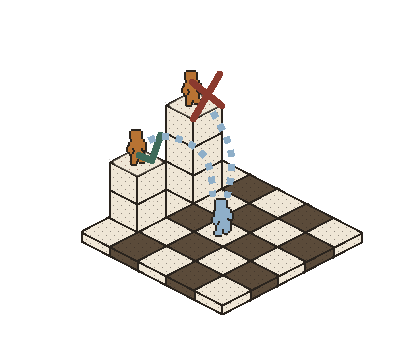
Vertical Attack:
- Downward Attack has no vertical restriction.
- Upward Attack has maximum reach of 2.
- Downward melee is rewarded with +1 damage to the total damage given, inversely attacking upwards has a penalty of -1 total damage.
Example:
Vertical attack demonstration showing upward and downward attack mechanics.
Reach  :
:
How many tiles your Attack reaches.
Reach Mechanics:
- Reach of 1 is considered melee. That is, adjacent, non diagonal tiles, that can either be level or +1/-1 vertical (up one, down one).
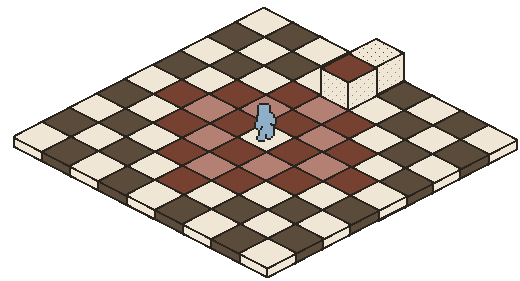
- Reach beyond 2 uses a radius of attack, this is a rough circle around the unit attacking.
Example:
Reach 3 example where any orange tile is a valid target.
Area of Effect (AOE)
(Area of Effect) refers to attacks or abilities that hit multiple targets.Attack reaches.
AOE Mechanics:
- AOE behaves the same as Reach above but originates from the targeted tile.
- AOE 1 is a + shape, see example below
- AOE 3x3 is a 3 by 3 grid
Example:
AOE 3x3 demonstration showing a 3 by 3 grid area of effect.
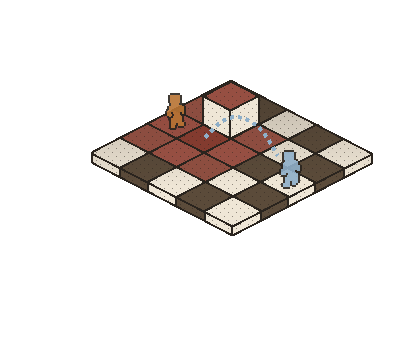
Line of sight (LOS)
LOS is required unless attacker has this icon: 
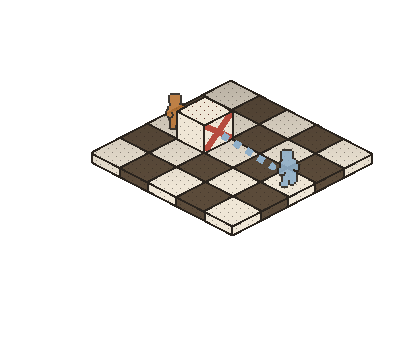
LOS Mechanics:
- Line of sight works by connecting a straight line through space from attacker to target.
If no other unit or terrain blocks this line then the Attack is valid.
Example:
Line of sight demonstration showing valid and invalid attack paths.
Push :
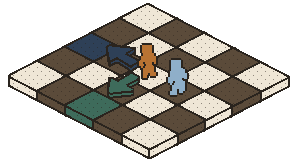
Force an target to move in this direction. This will cause an enemy to fall if pushed into open air.
Push is defined on cards by things like: B2, R1. etc.
B & R being the direction, and the number representing total tiles Pushed.
- B = Back
- R = Right
- L = Left
- F = Forward (Attacker & Target swap tiles)
Direction is in relation to the attacker's position.
Example:
B2 would put the Target in Blue square. L2 would put the Target in the Green Square.Example:
Push example showing B2 (Blue square) and L2 (Green square) target positions.
Fall Damage:
Fall damage is 1 damage per 1 vertical tile.
Fall Damage Mechanics:
- Each tile measures roughly 30mm cubed.
- If measurement is necessary, always round down.
Example:
105mm height would be rounded down to 90mm or 3 damage.
Common Questions  :
:
Can I move through enemy units?
No, you cannot move through enemy units. You can only move through friendly units.
What happens if a unit is pushed into another unit?
The pushed unit stops at the occupied tile. The occupying unit is not moved.
Can I attack diagonally?
Melee attacks (Reach 1) cannot be diagonal. Ranged attacks (Reach 2+) can target diagonally within their radius.
Do I need to measure exact heights?
Only when necessary. Most terrain is designed with clear tile heights. When measuring, always round down.